Applications for the September 2026 Qualifier are open. Apply by November 21, 2025. Apply now
Foundational Level Course

Computational Thinking

The students will be introduced to a number of programming concepts using illustrative examples which will be solved almost entirely manually. The manual execution of each solution allows for close inspection of the concepts being discussed.

Code BSCS1001
Credits 4 Credits
Type Foundational
Prerequisites None
Core Competencies

What You'll Learn

View Course Videos
  • Applying a procedural approach to real life problems: sequencing basic steps, identifying common patterns.

  • Communicating procedural descriptions: flowcharts, pseudo-code.

  • Understanding underlying abstractions used in programming, through examples: variables, iteration, accumulation, filtering, parametrised procedures, polymorphism and state.

  • Selecting appropriate data structures to store relationships between data: lists, trees, matrices, graphs.

  • Identifying algorithmic techniques to solve a given problem: searching, sorting, indexing, matching.

  • Decomposing problems into smaller units to find a solution: recursion, divide and conquer.

  • Understanding and checking algorithms: predict their behaviour, design tests to verify their output, perform simple debugging.

12-Week Roadmap

Course Structure & Syllabus

For details of standard term assessment timelines and exam structures, visit our Academics page.

WEEK 1
Variables, Initialization, Iterators, Filtering, Datatypes, Flowcharts, Sanity of data
WEEK 2
Iteration, Filtering, Selection, Pseudocode, Finding max and min, AND operator
WEEK 3
Multiple iterations (non-nested), Three prizes problem, Procedures, Parameters, Side effects, OR operator
WEEK 4
Nested iterations, Birthday paradox, Binning
Faculty & Experts

About the Instructors

Madhavan Mukund

Madhavan Mukund

Director , Chennai Mathematical Institute

Madhavan Mukund studied at IIT Bombay (BTech) and Aarhus University (PhD). He has been a faculty member at Chennai Mathematical Institute since 1992.His main research area is formal verification. He has active research collaborations within and outside India and serves on international conference programme committees and editorial boards of journals.

He has served as President of both the Indian Association for Research in Computing Science (IARCS) (2011-2017) and the ACM India Council (2016-2018). He has been the National Coordinator of the Indian Computing Olympiad since 2002. He served as the Executive Director of the International Olympiad in Informatics from 2011-2014.

In addition to the NPTEL MOOC programme, he has been involved in organizing IARCS Instructional Courses for college teachers. He is a member of ACM India's Education Committee. He has contributed lectures on algorithms to the Massively Empowered Classroom (MEC) project of Microsoft Research and the QEEE programme of MHRD.
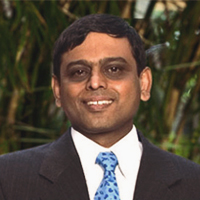
G Venkatesh

G Venkatesh

Professor of Practice , Department of Humanities and Social Sciences , IIT Madras

Dr. Venkatesh is a Professor of Practice at IIT Madras, where he is involved with several projects in the field of education. He is also a Fellow and Director of Sasken Communication Technologies Ltd, a leading Indian R&D services provider, and a founder of Mylspot, an education technology startup that aims to bridge knowledge gaps of students through a mentored learning platform.

Dr Venkatesh is a graduate in electronics from IIT Madras, PhD in Computer Science from TIFR, Mumbai and was a faculty member of the Computer Science & Engineering Dept of IIT Bombay for 8 years where his research interests revolved around declarative languages and their application to the design of embedded systems. He moved to the industry when Sasken was being formed, where he led their technology activities for over two decades. He was a visiting/adjunct faculty at IIM Bangalore for 10 years and a Chair Professor in the department of EE at IIT Madras for 3 years.

Dr. Venkatesh was elected as a fellow of the Indian National Academy of Engineers in 2006 and the IETE in 2012. He won the Technomentor award of the Indian Electronics and Semiconductor Association in 2013 and the Vasvik award for industrial research in 2015. Dr. Venkatesh serves on a number of government, industry and investor committees and boards in the areas of microelectronics, telecommunications and education.